Make
Schaeffer & Budenberg
Overview
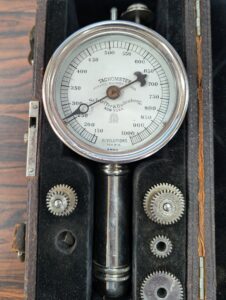
Schaeffer & Budenberg produced mechanical tachometers designed to measure rotational speed (typically in revolutions per minute, RPM) for industrial and laboratory applications. These instruments were commonly used in conjunction with steam engines, electric motors, and rotating machinery where accurate speed measurement was required.
Technical Specifications
| Category | Details |
|---|---|
| Manufacturer | Schaeffer & Budenberg |
| Product Type | Mechanical Tachometer |
| Measurement | Rotational speed (RPM) |
| Operating Principle | Mechanical contact or centrifugal mechanism |
| Display Type | Analog dial with pointer |
| Range | Varies by model (commonly hundreds to several thousand RPM) |
| Mounting | Handheld or panel-mounted (depending on model) |
| Construction | Metal housing with glass-covered dial |
Physical Description
Schaeffer & Budenberg tachometers are typically housed in a robust metal case with a circular analog dial. The face is marked with calibrated RPM scales and a single pointer. Units may include a contact tip or spindle interface for direct measurement of rotating shafts.
Handheld versions often resemble portable gauges with a knurled edge or protective casing, while fixed versions are designed for panel mounting in control equipment. The build quality reflects industrial use, with emphasis on durability and mechanical precision.
History
Mechanical tachometers from Schaeffer & Budenberg were produced during the late 19th and early to mid-20th century, aligning with the company’s broader focus on precision measurement instruments. These devices were used across industries including power generation, marine engineering, and manufacturing.
The tachometers complemented the company’s established line of pressure and test gauges, extending its instrumentation offerings into rotational measurement. As electronic measurement technologies advanced, mechanical tachometers were gradually replaced, but surviving examples remain in collections and industrial settings.
References
- https://www.gracesguide.co.uk/Schaeffer_and_Budenberg
Verified: Provides company background and product context relevant to instrumentation including tachometers