
Overview
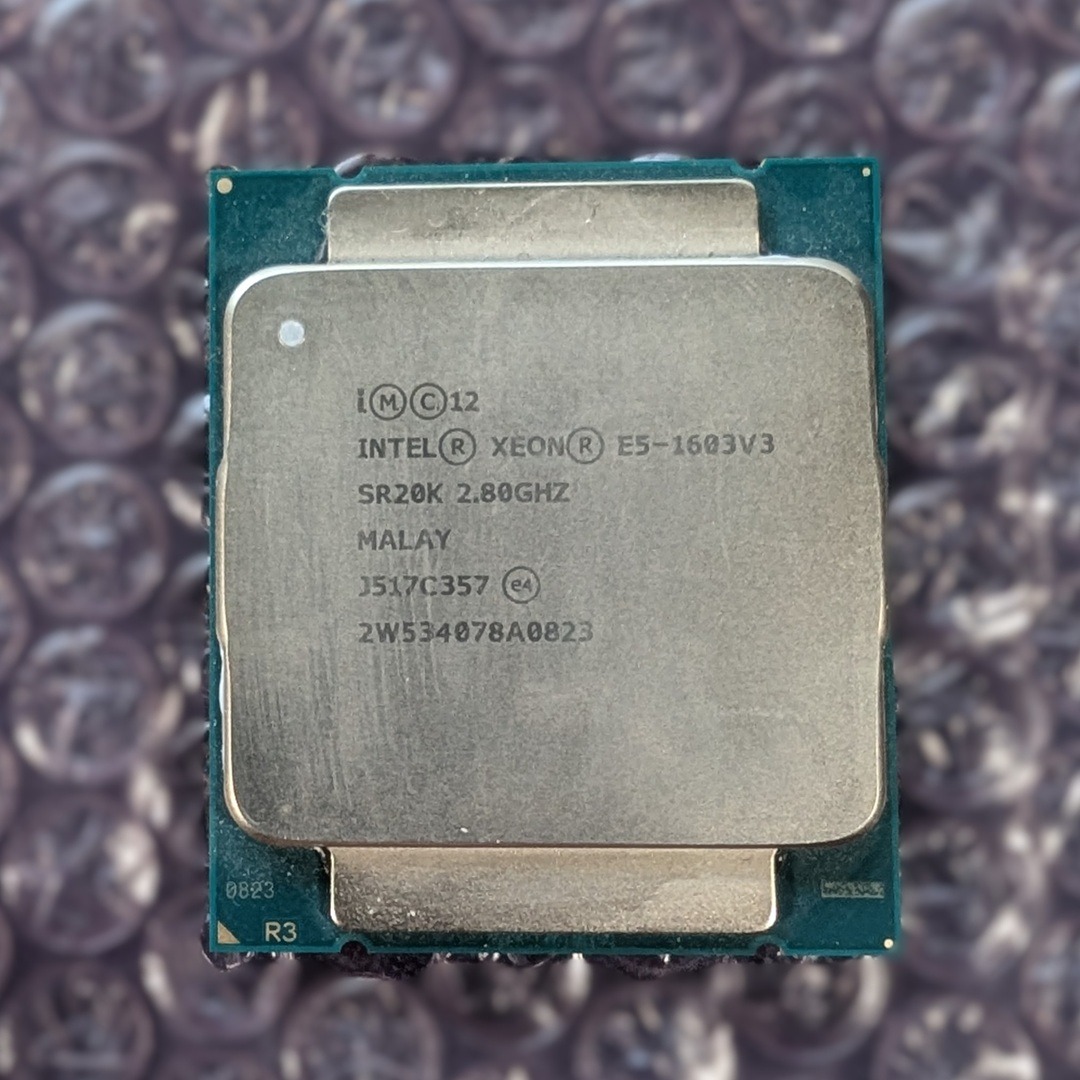
The Intel Xeon E5-1603 v3 is a 64-bit quad-core enterprise server and workstation microprocessor released by Intel Corporation in September 2014. Built on the 22-nanometer Haswell-EP microarchitecture and utilizing the LGA2011-v3 socket, the processor is engineered to handle entry-level single-socket server platforms, enterprise workstations, and embedded data storage systems. Operating at a fixed base frequency of 2.80 GHz without Turbo Boost, the processor provides dedicated execution pipelines and quad-channel memory support for industrial computing nodes.
Technical Specifications
| Attribute | Details |
| Manufacturer / Operator | Intel Corporation |
| Model Number | Xeon E5-1603 v3 |
| SPEC Code / S-Spec | SR20K |
| Architecture / Microarchitecture | Haswell-EP (22 nm Process) |
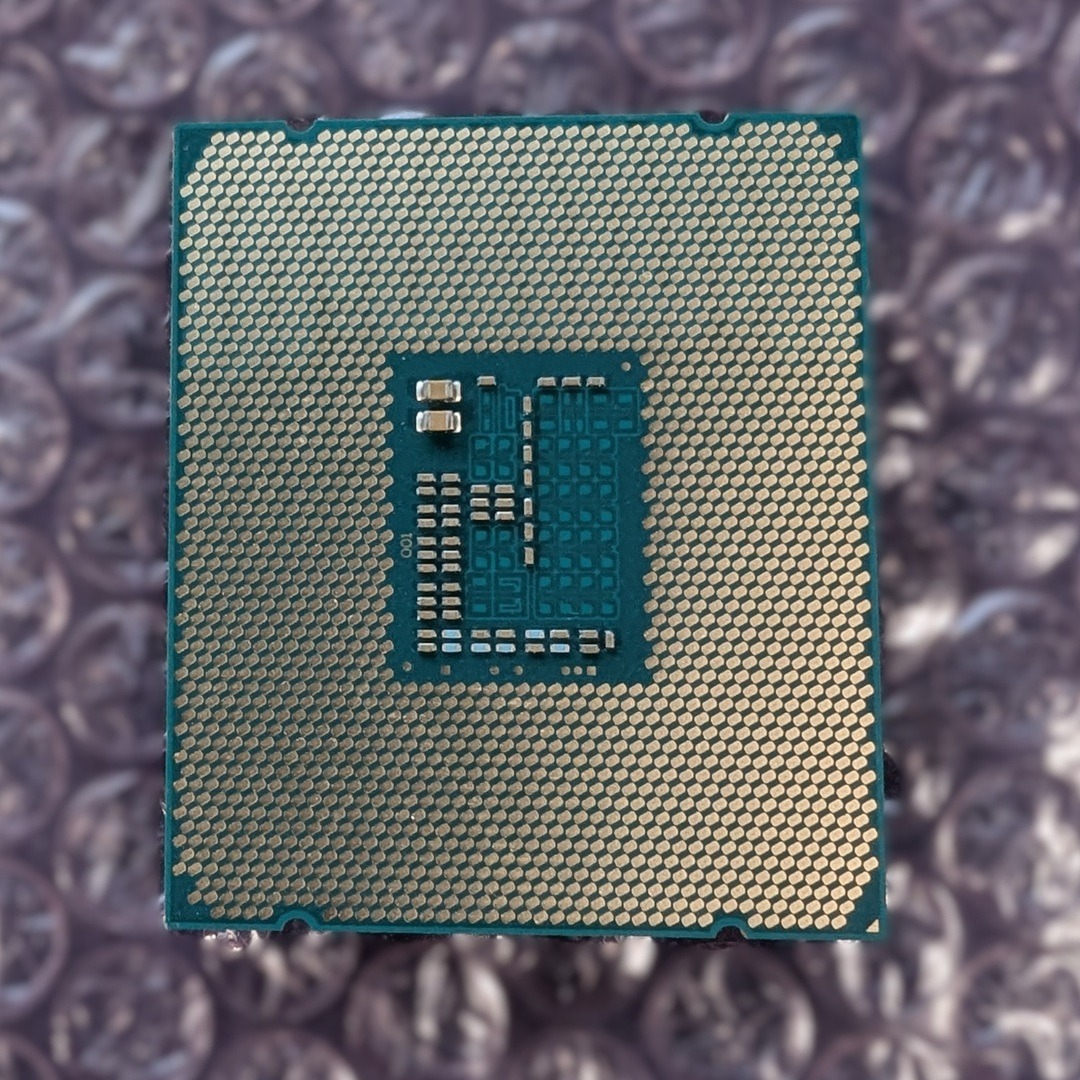
| Socket Interface | FCLGA2011-v3 (Socket R3) |
| Core / Thread Count | 4 Cores / 4 Threads (Non-Hyper-Threaded) |
| Base Clock Frequency | 2.80 GHz |
| L3 Smart Cache | 10 MB |
| Supported Memory Types | DDR4 1333 / 1600 / 1866 MHz (Quad-Channel, ECC Supported) |
| Thermal Design Power (TDP) | 140 W |
| PCI Express Revision | PCIe 3.0 (Up to 40 Lanes) |
| Launch Date | Q3 2014 |
Description
The Intel Xeon E5-1603 v3 functions as a specialized processing unit designed for single-socket enterprise platforms requiring continuous operational stability, error-correcting memory capabilities, and high I/O throughput. Built on Intel’s 22-nanometer Tri-Gate 3D transistor design, the die consolidates processing execution units, integrated memory controllers, and peripheral PCIe lanes onto a monolithic silicon substrate.
The processor architecture integrates several enterprise-focused operational layers:
- Haswell Execution Engine: Features 4 independent execution cores designed to execute instructions per cycle with AVX2 support, allowing 256-bit integer instruction execution for analytical computing loads.
- Integrated Memory Controller: Incorporates an internal 4-channel DDR4 memory controller capable of addressing enterprise system memory, fully supporting Error-Correcting Code unbuffered and registered DIMMs to prevent undetected single-bit data corruption.
- Direct I/O Connectivity: Connects directly to external hardware through 40 native PCI Express 3.0 lanes, enabling direct, high-bandwidth interfacing with discrete compute accelerators, RAID storage array cards, and high-speed enterprise network controllers without bottlenecking the chipset bus.
- Hardware Security & Virtualization: Integrates hardware-assisted Intel Virtualization Technology along with AES-NI encryption acceleration and Intel vPro security validation for remote system monitoring and data isolation.
History
Intel launched the Xeon E5-1600 v3 product family in September 2014 alongside the multi-socket E5-2600 v3 series, marking the commercial transition of enterprise server platforms from DDR3 to high-bandwidth DDR4 system memory. While higher-tier models in the E5-1600 family targeted multi-threaded compute workstations with unlocked multipliers and Hyper-Threading, the E5-1603 v3 was introduced as a cost-efficient, entry-level workhorse chip for dedicated communications gateways, network-attached storage towers, and OEM single-socket workstation builds.
Throughout the mid-2010s, major system manufacturers including Dell, HP, and Lenovo deployed the E5-1603 v3 across commercial infrastructure setups. The processor served as an entry platform for businesses needing the expansive I/O lane capacity and ECC memory reliability of the C612 chipset platform without requiring the premium multi-core scaling or higher power envelopes of multi-socket server hardware.
Historical Timeline
| Year | Event |
| 2014 | Intel officially announces and releases the Xeon E5-1603 v3 processor based on the 22 nm Haswell-EP microarchitecture. |
| 2015 | Major enterprise workstation and server OEMs integrate the E5-1603 v3 into entry-level single-socket product tiers. |
| 2016 | Intel introduces the succeeding Broadwell-EP E5-1600 v4 series, transitioning server microarchitecture to the 14 nm node. |
| 2020 | The E5-1600 v3 series reaches end-of-life status for direct volume production, shifting into secondary enterprise spare parts maintenance. |
| 2026 | The processor remains in active use in legacy server infrastructure, homelab virtualization servers, and industrial embedded systems. |
References
- https://www.intel.com/content/www/us/en/products/sku/82761/intel-xeon-processor-e51603-v3-10m-cache-2-80-ghz/specifications.html – Official Intel ARK technical specifications directory detailing the Xeon E5-1603 v3 launch timing, Haswell architecture, 140W TDP, memory bandwidth, and supported instruction sets.
- https://www.techpowerup.com/cpu-specs/xeon-e5-1603-v3.c2669 – Technical database entry documenting physical die size, 2,600 million transistor count, Socket 2011-3 compatibility, and hardware virtualization profiles for the Xeon E5-1603 v3.
- https://www.cpubenchmark.net/cpu.php?cpu=Intel+Xeon+E5-1603+v3+%40+2.80GHz&id=2457 – Comprehensive benchmark tracking database detailing integer math, floating point performance, and real-world multi-threaded PassMark metrics for the Intel Xeon E5-1603 v3.