Overview
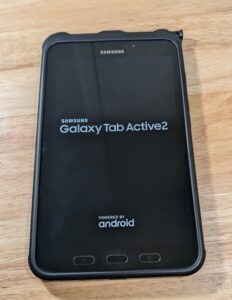
The Samsung Galaxy Tab Active2 is a rugged Android tablet designed for use in industrial, commercial, and field environments. It is built to withstand harsh conditions while providing mobile computing capabilities, making it suitable for applications such as logistics, public safety, utilities, and service operations.
The device supports glove operation, features enhanced durability, and offers integrated tools intended for professional use.
Technical Specifications
| Item | Details |
|---|---|
| Model | Galaxy Tab Active2 |
| Manufacturer | Samsung Electronics |
| Release Year | 2017 |
| Operating System | Android (upgradable versions vary) |
| Display | 8.0-inch TFT LCD |
| Resolution | 1280 × 800 pixels |
| Processor | Exynos 7870 Octa-core |
| Memory | 3 GB RAM |
| Storage | 16 GB internal (expandable via microSD) |
| Connectivity | Wi-Fi, Bluetooth, optional LTE |
| Camera (Rear) | 8 MP |
| Camera (Front) | 5 MP |
| Battery | 4,450 mAh (user-replaceable) |
| Charging | USB and pogo pin docking |
| Protection Rating | IP68 water and dust resistance |
| Durability Standard | MIL-STD-810G |
Physical Description
The Galaxy Tab Active2 features a ruggedized enclosure with reinforced corners and a textured exterior designed for secure handling. It includes physical navigation buttons on the front panel, allowing operation in environments where touch input may be limited.
The tablet is typically supplied with a protective case and S Pen stylus, both designed for use in demanding conditions. The device supports wet and glove touch input, making it suitable for outdoor or industrial use.
The rear housing includes a removable back cover to access the battery and SIM/microSD slots. A pogo pin connector enables docking and charging in vehicle mounts or workstations.
History
The Galaxy Tab Active2 was introduced as part of Samsung’s rugged device lineup, following the original Galaxy Tab Active series. It expanded on earlier designs by improving processing performance, adding biometric security features such as fingerprint recognition, and enhancing S Pen functionality.
The device was targeted at enterprise and government users who require durable mobile hardware capable of operating in challenging environments. It remained in use across various industries due to its combination of portability, durability, and replaceable battery design.