Overview
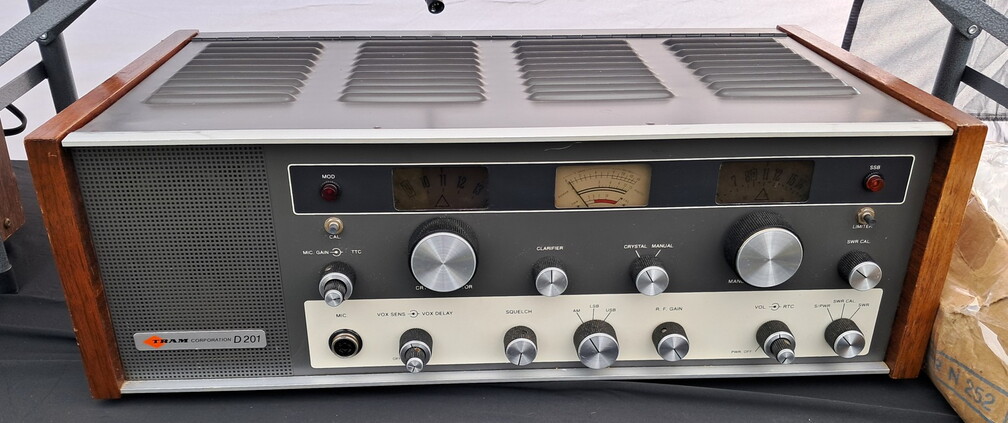
The Tram D201 was a high-performance 23-channel CB base station transceiver manufactured in the United States during the late 1960s and early 1970s. It became one of the most recognized and respected tube-type CB base stations of the classic CB era.
Early D201 models featured VOX capability and a steel chassis construction. Later production versions eliminated the VOX circuitry and transitioned to printed circuit board (PCB) construction.
The D201 developed a strong reputation for excellent receiver sensitivity, loud transmit audio, and durable construction.
Technical Specifications
| Item | Details |
|---|---|
| Brand | Tram |
| Model | D201 |
| Made In | USA |
| Type | CB Base Station Transceiver |
| Channels | 23 |
| Modes | AM |
| Frequency Range | 26.965 MHz – 27.255 MHz |
| Power Source | 117 VAC |
| Construction | Tube / hybrid |
| Speaker | Built-in |
| Meter | Analog multifunction meter |
Production Variations
| Version | Features |
|---|---|
| Early D201 | VOX capability, steel chassis |
| Later D201 | PCB construction, no VOX |
Microphone Wiring
| Pin | Function |
|---|---|
| 1 | Audio |
| 2 | Shield |
| 3 | Receive |
| 4 | Transmit |
Physical Description
The Tram D201 used a large desktop base station cabinet with a brushed aluminum front panel, analog meter, illuminated channel display, and integrated speaker.
Front panel controls typically included:
- Volume
- Squelch
- RF gain
- Delta tune
- Channel selector
- PA/CB controls
- Tone controls
The large cabinet styling and chrome trim made the D201 visually distinctive among CB base stations of the era.
History
The Tram D201 was introduced during the height of the 23-channel tube CB era and quickly became popular with serious CB operators.
The radio competed directly with premium base stations from Browning, Courier, Johnson, Sonar, and Lafayette. Its strong receiver performance and audio quality helped establish the D201 as one of Tram’s best-known products.
Early units featuring VOX circuitry and steel chassis construction are especially sought after by collectors today.
References
- CBTricks
https://cbtricks.org/ - World Radio History
https://www.worldradiohistory.com/ - RigPix Communications Equipment Database
https://www.rigpix.com/ - Internet Archive
https://archive.org/
