Overview
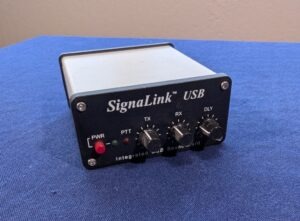
The Tigertronics SignaLink USB is a radio-to-computer interface designed for amateur radio digital communications. It combines a USB sound card, audio isolation circuitry, and PTT (Push-To-Talk) control into a single external device, allowing a transceiver to communicate with computer software used for digital modes.
The SignaLink USB became one of the most widely used digital-mode interfaces in amateur radio due to its simple installation, broad radio compatibility, and support for virtually all sound-card-based digital communications software.
Technical Specifications
| Specification | Details |
|---|---|
| Product Name | SignaLink USB |
| Manufacturer | Tigertronics |
| Product Type | USB Sound Card Radio Interface |
| Power Source | USB Powered |
| Computer Interface | USB 1.1 / 2.0 Compatible |
| Radio Interface | RJ-45 with model-specific radio cable |
| Audio Isolation | Transformer Isolated |
| PTT Control | Relay-Based |
| Audio Frequency Response | Approximately 200 Hz to 4000+ Hz |
| Operating Modes | FT8, FT4, JS8Call, PSK31, RTTY, SSTV, WSPR, VARA, EchoLink, CW and others |
| Dimensions | 3.2 × 1.6 × 3.6 inches |
| Case Material | Extruded Aluminum |
| Status | Current Production |
Physical Description
The SignaLink USB is housed in a compact extruded aluminum enclosure with front-panel controls for transmit audio, receive audio, and transmit delay adjustment. Status LEDs provide indication of power and transmit operation.
The rear panel includes USB, monitor, auxiliary speaker, and radio-interface connections. The unit is designed to connect to a radio through interchangeable model-specific cables and jumper configurations.
History
Tigertronics introduced the SignaLink USB as an evolution of its earlier SL-1+ interface. By incorporating a built-in USB sound card, the design eliminated dependence on a computer’s internal sound hardware and simplified installation.
As digital operating modes such as PSK31, JT65, FT8, FT4, JS8Call, and VARA became increasingly popular, the SignaLink USB became one of the most commonly recommended interfaces for amateur radio operators. Its compatibility with a wide range of transceivers and software packages contributed to its widespread adoption.
The product remains in production and continues to be used by amateur radio operators worldwide.
References
- https://tigertronics.com/slusbmain.htm — Official Tigertronics SignaLink USB product page with features, specifications, compatibility information, and installation details.
- https://tigertronics.shop/shop/ols/categories/signalink-usb — Official Tigertronics SignaLink USB product catalog and current models.
- https://www.dxengineering.com/parts/tgr-sl-usb/media/instructions — SignaLink USB features and installation information from DX Engineering.
- https://www.universal-radio.com/catalog/tnc/5718spec.html — Detailed SignaLink USB specifications and technical data.